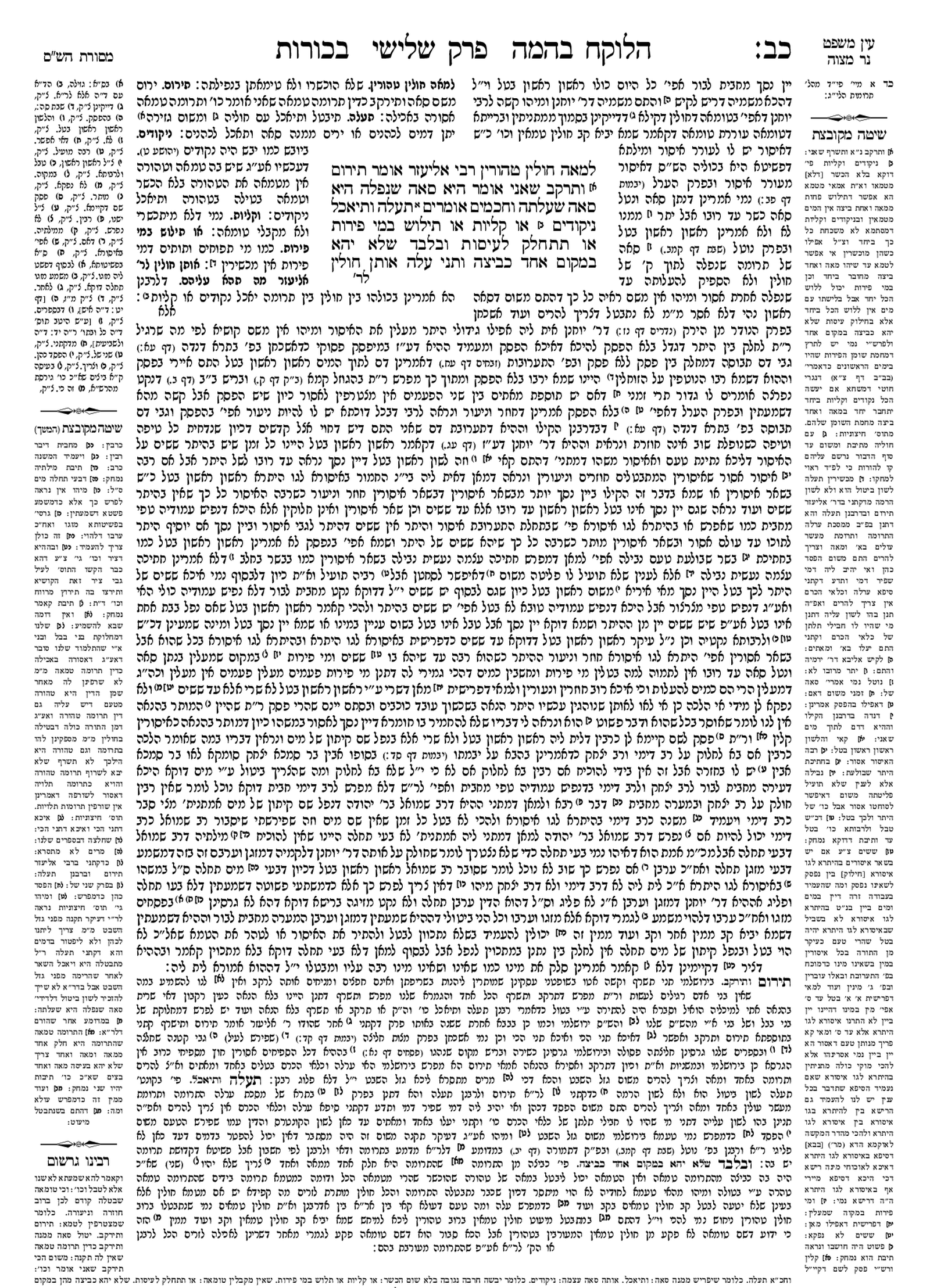
Page source, attribution and redistribution license
Scanned Shas provided courtesy of Shas.org, HebrewBooks.org and Moznaim (הוצאת ח. וגשל). Redistributed free for non-commercial educational use under the HebrewBooks Limited License.
HebrewBooks.org Limited License — Paragraph 1
1. Limited License: The Society for the Preservation of Hebrew Books hereby grants you a limited, nonexclusive right and license, solely for your personal use, to use the Site view, download, and print the Publications, subject to the following restrictions:
(a) No commercial use: a Publication may be used for personal use (including educational use) and not for any commercial purpose;
(b) No resale: you may not sell a copy of any Publication (or bundle any Publication with any other product that is sold for a fee), and you may not charge any fee for the use of any Publication; and
(c) Local Law: you may not use any Publication in violation of applicable law.
Subject to applicable law, you may distribute print or electronic copies of any Publication to any third party free of charge for personal use only and for use in accordance with the terms of this license. If you distribute copies of the Publications to any third party, you must retain any attribution notices that appear in such copies, and you must provide the third party with a complete copy of the limited license set out in this Paragraph 1 of these Terms of Use, including the restrictions on further distribution.
Daily learning archive: 60 days before and 60 days after today. Earlier lessons remain available; upcoming lessons may be previewed. Nothing is scheduled to publish automatically on Shabbat or Yom Tov.
The Gemara notes with regard to the ruling of the mishna that the animal is exempt from having any future offspring counted as firstborn: That is to say that the expelled mass is a full-fledged offspring. But if so, why doesn’t it impart ritual impurity, neither through physical contact nor through carrying? Rabbi Yoḥanan says: It is due to the halakhic nullification of a forbidden substance in a majority of permitted substances that the Sages touched upon it, in order to exclude it from impurity through contact or carrying. In other words, the fetus is in fact considered a full-fledged offspring, but it does not impart impurity because it is nullified by the rest of the congealed mass.
The Gemara comments: And Rabbi Yoḥanan follows his line of reasoning in this regard, as Rabbi Yoḥanan says: Rabbi Eliezer ben Yaakov and Rabbi Shimon both said the same thing, i.e., they both issued rulings based on the same principle. The relevant statement of Rabbi Eliezer ben Yaakov is that which we said previously, i.e., that the expelled mass does not impart ritual impurity because the fetus is nullified by the majority.
And what is the statement of Rabbi Shimon to which Rabbi Yoḥanan was referring? It is as we learned in a mishna (Nidda 18a): If a woman miscarried and the afterbirth is in the house, the house is impure. The reason is not that the afterbirth itself has the status of an offspring, but that there is no afterbirth without an offspring within it, even if it is undetected. Rabbi Shimon says: The offspring disintegrated before it emerged with the afterbirth. Consequently, the house is not rendered impure, because the disintegrated fetus is nullified by the majority.
§ The Gemara continues discussing the ritual impurity imparted by a fetus. We learned in a mishna elsewhere (Oholot 7:4): If a fetus dies in its mother’s womb, it imparts ritual impurity from when the womb opens. Yet deceased fetuses do not impart ritual impurity in this manner even during the opening of the womb, until the head of the fetus is round like the size of a skein [pika] of yarn. The Gemara asks: What is the meaning of: Like a skein? Rav Huna said: It means like a skein of woolen yarn. Ḥiyya bar Rav said to Rav Huna: My teacher, explain your statement: Were you referring to a skein of warp threads or a skein of the thicker woof threads?
Rav Huna said to him: It is taught in a baraita (Tosefta, Oholot 8:5): Deceased fetuses do not impart ritual impurity until the head of the fetus is the size of a skein of warp threads; this is the statement of Rabbi Meir. Rabbi Yehuda says: The head must be the size of a skein of woof threads. Rabbi Eliezer, son of Rabbi Tzadok, says: The fetus imparts ritual impurity from the time that tefifiyot are seen near the opening of the womb. The Gemara asks: What are tefifiyot? Rav Yehuda says that Shmuel says in the name of Rabbi Eliezer, son of Rabbi Tzadok: This is how they would explain it in Jerusalem:Tefifiyot are like the folds of skin that form when a mule bends down to urinate, and the area near the womb appears as a skein emerging from within a skein.
Rav Huna says: I heard two different halakhot with regard to skeins: One involves a skein of warp threads and the other one involves a skein of woof threads, and I do not have the knowledge to explain to which matter these halakhot refer. When Rav Dimi came to Babylonia from Eretz Yisrael, he said that Rabbi Yoḥanan said: With regard to skeins, I heard three different halakhot: One involves a skein of warp threads, and one a skein of woof threads, and one a large skein used by sack makers, and I do not have the knowledge to explain to which matter these halakhot refer. When Ravin came to Babylonia from Eretz Yisrael, he explained this in the name of Rabbi Yoḥanan: To impart ritual impurity, the head of a fetus in the womb of a woman must be the size of a skein of warp threads, and the head of an animal fetus must be the size of a skein of woof threads.
As for the halakha involving a large skein used by sack makers, it is as we learned in a baraita (Tosefta, Kelim Bava Metzia 7:1): For it to impart ritual impurity, a clod of earth that comes from an area in which uncertainty exists concerning the location of a grave or a corpse [beit haperas], or from the land of the gentile nations, must be of the measure of a large skein used by sack makers, the size of which is like the seal of large sacks [martzofin]. And an item of this size is also found on the top side of the seal of a Bethlehem jug.
§ Reish Lakish says in the name of Rabbi Yehuda Nesia: One who purchases fish brine from one who is unreliable with regard to ritual impurity [am ha’aretz], who must purify it due to the concern that it was rendered impure while in the seller’s possession, brings it into contact with the water of a ritual bath so that the water touches the brine, and it is thereby rendered pure.
Reish Lakish explains: The brine is pure whichever way you look at it: If water is the majority of the brine mixture, once he brought the brine into contact with the ritual bath, the water in the brine mixture became pure and the impurity of the brine is nullified by the majority of pure water. And if the majority is the brine excreted by the fish itself it is also pure, as brine alone is not susceptible to ritual impurity. Consequently, what impurity is there? Any impurity is due only to that minority of water in the mixture, and that water is nullified by the majority of brine.
Rabbi Yirmeya says: The Sages taught that one should use that method of purification only if he wishes to dip his bread in the brine. But for cooking in a pot with other water this method is not effective, as the liquid of the type that was nullified, i.e., the water in the brine, found its own type, the water in the pot, and is revived in its impure state, as the water which was previously only a minority of the mixture is now the majority. Rav Dimi was sitting and saying this halakha. Abaye said to Rav Dimi: But does nullified impurity return and revive in its impure state? Rav Dimi said to him: And you, do you not hold that this is the halakha? But didn’t we learn in a mishna (Teruma 5:2): With regard to a se’aof impure teruma that fell
into one hundredse’a of pure, non-sacred produce, Rabbi Eliezer says: Let one se’abe lifted from the mixture and left to rot as impure teruma, as I say: The se’a that fell is the se’a that arose?
And the Rabbis say: Let the se’a of terumaarise and be nullified by the one hundred se’a of non-sacred produce, and then all one hundred and one se’a will be considered non-sacred. Nevertheless, the mixture may not be allowed to come in contact with water, so that it does not become susceptible to ritual impurity, and therefore it must be eaten dry or roasted. Or alternatively, it may be kneaded with fruit juice, which does not render a substance susceptible to impurity. Or alternatively, if one wants to knead it with water, it may be divided into small batches, provided that there is not an egg-bulk of terumain a single batch, as an egg-bulk is the minimum volume needed for food to be susceptible to contracting impurity.
וְתָנֵי עֲלַהּ: אוֹתָן חוּלִּין
And it is taught in that regard: Concerning those one hundred se’a of non-sacred produce,
Text from The William Davidson digital edition of the Koren Noé Talmud, translated and commented on by Rabbi Adin Even-Israel Steinsaltz, published by Koren Publishers. CC BY-NC 4.0, noncommercial use only. Source: Sefaria. The bilingual edition is separate from the traditional Daf display.
An original commentary summary has not yet been published for this date. Study the complete Gemara in the bilingual reader above.
Daf Yomi assignments: Hebcal. Full text: Sefaria. The date picker and archive links are available every day, including Shabbat and festivals; no scheduled publication is required.