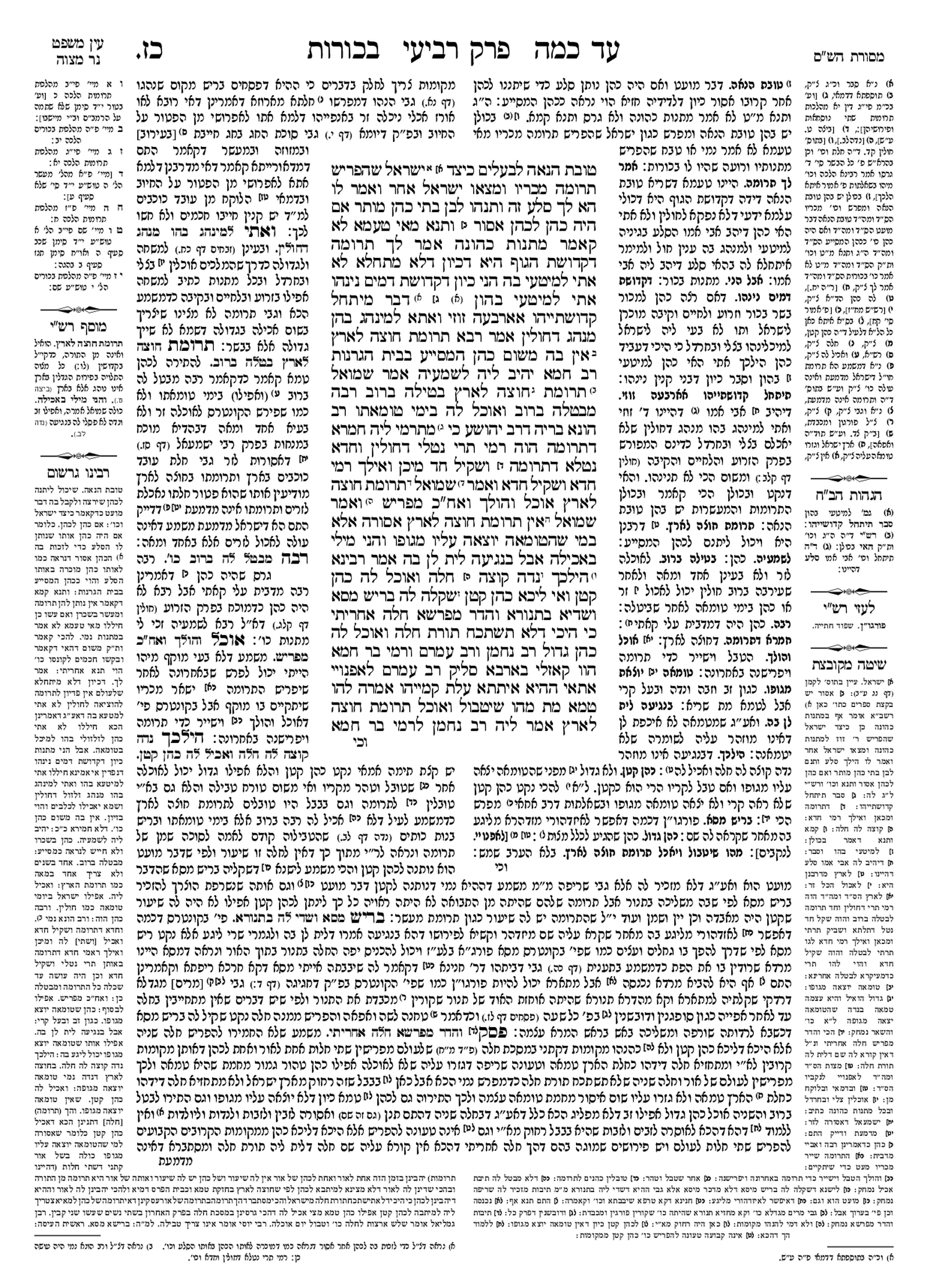
Page source, attribution and redistribution license
Scanned Shas provided courtesy of Shas.org, HebrewBooks.org and Moznaim (הוצאת ח. וגשל). Redistributed free for non-commercial educational use under the HebrewBooks Limited License.
HebrewBooks.org Limited License — Paragraph 1
1. Limited License: The Society for the Preservation of Hebrew Books hereby grants you a limited, nonexclusive right and license, solely for your personal use, to use the Site view, download, and print the Publications, subject to the following restrictions:
(a) No commercial use: a Publication may be used for personal use (including educational use) and not for any commercial purpose;
(b) No resale: you may not sell a copy of any Publication (or bundle any Publication with any other product that is sold for a fee), and you may not charge any fee for the use of any Publication; and
(c) Local Law: you may not use any Publication in violation of applicable law.
Subject to applicable law, you may distribute print or electronic copies of any Publication to any third party free of charge for personal use only and for use in accordance with the terms of this license. If you distribute copies of the Publications to any third party, you must retain any attribution notices that appear in such copies, and you must provide the third party with a complete copy of the limited license set out in this Paragraph 1 of these Terms of Use, including the restrictions on further distribution.
Daily learning archive: 60 days before and 60 days after today. Earlier lessons remain available; upcoming lessons may be previewed. Nothing is scheduled to publish automatically on Shabbat or Yom Tov.
Thursday, October 15, 2026
Bechorot 27
Read the Daf — English Translation
Bekhorot 27a
טוֹבַת הֲנָאָה לַבְּעָלִים.
the benefit of discretion for the owners of the produce, i.e., benefit accrued from the option of giving teruma and tithes to any priest or Levite of their choosing.
The baraita continues: How so? With regard to an Israelite who separated teruma from his pile of grain, and another Israelite found him and said to him: Take this sela coin for yourself and give the teruma and tithes to my daughter’s son who is a priest, it is permitted. But if it was a priest who gave the sela coin for the right to give the teruma and tithes to another priest, it is prohibited. Priests may not pay for the gifts that they receive.
The Gemara asks: And according to the tanna of this baraita, what is the reason that he does not state that the owners also have the benefit of discretion with regard to the gifts of the priesthood, i.e., the foreleg, jaw, and maw, which must be given to the priest from every non-sacred animal that one slaughters? Why does he mention teruma alone? The Gemara answers that he could have said to you: In the case of teruma, which has inherent sanctity, and which therefore cannot be redeemed, the priest will not come to err with it and treat it as though it has no sanctity, even if the owner receives payment for it.
By contrast, with regard to these gifts of the priesthood, since they have sanctity that inheres in their value, which means that once the priest has received them he may sell them, the priest might come to err with them by saying that the sanctity that they have can be redeemed with four zuz, i.e., the one sela, and he might come to treat them in the manner that one treats non-sacred food. This would be a mistake, as a priest must eat his priestly gifts in a dignified manner, i.e., roasted and with seasoning (see Ḥullin 132b).
§ On a related topic, Rava says: Teruma from outside of Eretz Yisrael does not have any prohibition due to a priest assisting at the threshing floor. The Sages decreed that one must separate teruma from produce grown in certain places outside of Eretz Yisrael. Yet, the halakhot governing this teruma are not as stringent as those that apply to teruma from produce grown within Eretz Yisrael. Consequently, one may give such teruma to a priest for helping at the threshing floor. In support of this claim, the Gemara relates that Rav Ḥama gaveteruma from outside of Eretz Yisrael to his servant, who was a priest, as his wages.
With regard to teruma from outside of Eretz Yisrael, Shmuel says: Teruma from outside of Eretz Yisrael that became mixed with non-sacred produce is nullified in a majority, unlike ordinary teruma, which requires one hundred parts of non-sacred produce to nullify it. The Gemara relates that Rabba, who was a priest, would nullify his teruma from outside of Eretz Yisrael in a majorityab initioand eat it during his days of impurity. Both of these acts are prohibited in the case of teruma from produce grown in Eretz Yisrael.
The Gemara relates: Rav Huna, son of Rav Yehoshua, when he would happen to have wine of teruma from produce grown outside of Eretz Yisrael, would pour two jugs of non-sacred wine and one jug of teruma wine into a vat in order to nullify the teruma wine, and then take out one jug’s worth of wine to drink. Having done so, from here onward every time he received more teruma wine grown outside of Eretz Yisrael, he would pour one jug of teruma wine into the same vat, which still contained two jugs’ worth of wine, and take out one jug’s worth of wine.
And Shmuel further says: Teruma from produce grown outside of Eretz Yisrael does not need to be separated before one eats the produce. Rather, one may proceed to eat and afterward separate the teruma from the remainder.
And Shmuel also says: Teruma from outside of Eretz Yisrael is prohibited only to a member of a priestly household whose impurity comes from his body, e.g., a man who experiences a seminal emission or a menstruating woman. It is not prohibited to a priest who came into contact with a corpse, an animal carcass, or the carcass of a creeping animal. And this statement, that such teruma is forbidden to one whose impurity comes from his body, applies only with regard to eating it. But with regard to touchingteruma from outside of Eretz Yisrael, we have no problem with it.
Ravina says: Therefore, a menstruating woman, whose impurity comes from her body, may separate ḥalla from dough outside of Eretz Yisrael, and a minor priest, who has never experienced a seminal emission and is therefore ritually pure, may eat it. And if there is no minor priest available, she takes the ḥallawith the top of a skewer [massa] and throws it in the oven, and then separates another piece from the dough as ḥalla, not because it is necessary but so that the halakhic category of ḥalla should not be forgotten. And an adult priest may eat it, even if he is ritually impure.
The Gemara relates that Rav Naḥman, Rav Amram, and Rami bar Ḥama were traveling in a ferry. Rav Amram went to relieve himself. A certain woman came before Rav Naḥman and Rami bar Ḥama and said to them: In the case of one who is impure through contact with a corpse, what is the halakhawith regard to whether he may immerse himself in a ritual bath and partake of teruma from outside of Eretz Yisrael? Rav Naḥman said to Rami bar Ḥama:
But do we have sprinkling of the ashes of the red heifer? Since without such sprinkling one remains impure after contact with a corpse, how does it help to immerse in a ritual bath? Rami bar Ḥama said to him: Shouldn’t Rav Naḥman be concerned for the opinion of the old man, i.e., Rav Amram? Wouldn’t it be better to wait until he returns before answering? Meanwhile, Rav Amram came back. He said to them that this is what Rav says: One who became impure with impurity imparted by a corpse may immerse and partake of teruma from produce grown outside of Eretz Yisrael.
The Gemara comments: But the halakha is not in accordance with his opinion. Mar Zutra said in the name of Rav Sheshet: One who became impure through contact with the carcass of a creeping animal may immerse in a ritual bath and partake of teruma from produce grown outside of Eretz Yisrael. But the halakha is not in accordance with his opinion.
§ The mishna teaches: The firstborn animal is eaten year by year, i.e., within its first year, whether it is blemished or unblemished. The Gemara comments: From the fact that the mishna says: If a blemish developed within its first year, rather than within the first year, that is to say that we count according to its year, not by the calendar year. In other words, the year is calculated from the day of the animal’s birth. From where is this matter derived?
It is derived from a verse, as Rav Yehuda says that Rav says that the verse states: “You shall eat it before the Lord your God, year by year [shana beshana] in the place that the Lord shall choose, you and your household” (Deuteronomy 15:20). The phrase “shana beshana,” which can also be translated as: A year in a year, indicates that the verse is referring to one year that enters another year. Which type of year enters another year? You must say that this is speaking of the year of the firstborn animal, which enters the following calendar year, since if the animal is born in the middle of the year, its first year includes part of the subsequent calendar year.
The school of Rav taught that there is a different halakha derived from the phrase “year by year.” This phrase indicates that it may be eaten on one day of this year and one day of that next year. The verse thereby taught with regard to an unblemished firstborn animal, which is sacrificed in the Temple, that it is eaten for two days and one night, like a peace offering.
The Gemara asks: From where does the school of Rav derive the halakha that a firstborn must be eaten within its own year and that its year is not calculated according to the calendar year? They derive it from the halakha of other sacrificial animals, whose age is counted from their birth rather than by the calendar year. And with regard to the other sacrificial animals themselves, from where do we derive that their age is counted from their birth? Rav Aḥa bar Yaakov says that the verse states: “And when the days of her purification are fulfilled, for a son or for a daughter, she shall bring a lamb in its first year for a burnt offering, and a pigeon or a dove for a sin offering, to the door of the Tent of Meeting, to the priest” (Leviticus 12:6). This description of the lamb is referring to its own year, and not a year of the counting of the world.
The Gemara asks: And Rav, from where does he derive that a firstborn is eaten for two days and one night? The Gemara answers: He derives it from a verse in which Moses spoke to Aaron and his sons with regard to eating the firstborn: “And their flesh shall be yours, as the breast of waving and as the right thigh, it shall be yours” (Numbers 18:18). The verse thereby juxtaposed the halakha of the firstborn with the breast and thigh of a peace offering. Just as there, it may be eaten for two days and one night, as stated explicitly in a verse (see Leviticus 7:16), so too here, a firstborn may be eaten for two days and one night.
Text from The William Davidson digital edition of the Koren Noé Talmud, translated and commented on by Rabbi Adin Even-Israel Steinsaltz, published by Koren Publishers. CC BY-NC 4.0, noncommercial use only. Source: Sefaria. The bilingual edition is separate from the traditional Daf display.
An original commentary summary has not yet been published for this date. Study the complete Gemara in the bilingual reader above.
Daf Yomi assignments: Hebcal. Full text: Sefaria. The date picker and archive links are available every day, including Shabbat and festivals; no scheduled publication is required.