Page source, attribution and redistribution license
Scanned Shas provided courtesy of Shas.org, HebrewBooks.org and Moznaim (הוצאת ח. וגשל). Redistributed free for non-commercial educational use under the HebrewBooks Limited License.
HebrewBooks.org Limited License — Paragraph 1
1. Limited License: The Society for the Preservation of Hebrew Books hereby grants you a limited, nonexclusive right and license, solely for your personal use, to use the Site view, download, and print the Publications, subject to the following restrictions:
(a) No commercial use: a Publication may be used for personal use (including educational use) and not for any commercial purpose;
(b) No resale: you may not sell a copy of any Publication (or bundle any Publication with any other product that is sold for a fee), and you may not charge any fee for the use of any Publication; and
(c) Local Law: you may not use any Publication in violation of applicable law.
Subject to applicable law, you may distribute print or electronic copies of any Publication to any third party free of charge for personal use only and for use in accordance with the terms of this license. If you distribute copies of the Publications to any third party, you must retain any attribution notices that appear in such copies, and you must provide the third party with a complete copy of the limited license set out in this Paragraph 1 of these Terms of Use, including the restrictions on further distribution.
Daily learning archive: 60 days before and 60 days after today. Earlier lessons remain available; upcoming lessons may be previewed. Nothing is scheduled to publish automatically on Shabbat or Yom Tov.
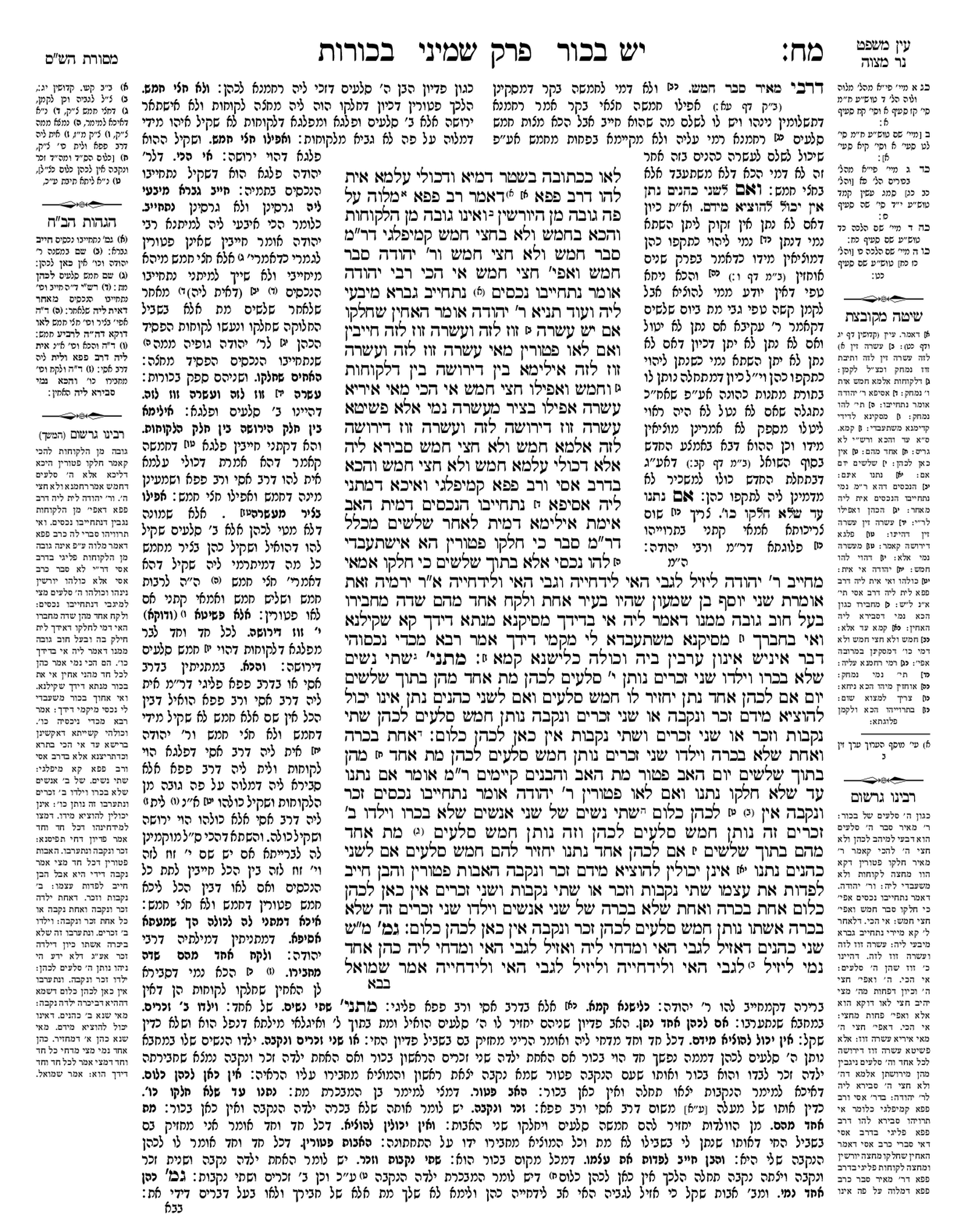
MISHNA: With regard to one whose wife had not previously given birth and then gave birth to two males, i.e., twin males, and it is unknown which is the firstborn, he gives five sela coins to the priest after thirty days have passed. If one of them dies within thirty days of birth, before the obligation to redeem the firstborn takes effect, the father is exempt from the payment due to uncertainty, as perhaps it was the firstborn who died.
In a case where the father died and the sons are alive, Rabbi Meir says: If they gave the five sela coins to the priest before they divided their father’s property between them, they gave it, and it remains in the possession of the priest. But if not, they are exempt from giving the redemption money to the priest. Rabbi Yehuda says: The obligation to redeem the firstborn already took effect on the property of the father; therefore, in either case the sons, his heirs, are required to pay the priest. If the wife gave birth to a male and a female and it is not known which was born first, the priest has nothing here, as it is possible that the female was born first.
GEMARA: The mishna teaches that in a case where the father died and the sons are alive, Rabbi Meir says: If they gave the five sela coins to the priest before they divided their father’s property, they gave it; but if not, they are exempt from giving the redemption money. The Gemara asks: When did the father die? If we say that he died after the thirty days following the birth of his sons, does Rabbi Meir say in this case that if they divided their father’s property they are exempt from giving the redemption money to the priest? But the property is already on lien for the mitzva of redemption.
Rather, it is referring to a case where the father died within thirty days of the birth of his sons, and the obligation of redemption applies to the firstborn himself, whose identity is unknown, but not to the father’s property. If so, what is different about a case where they already divided the property between them, that Rabbi Meir deems them exempt? The reason must be that the priest will go to this son, and the son will reject him by demanding that the priest prove he is the firstborn; and likewise he will go to that other son, and he too will reject him in the same manner. The Gemara challenges this explanation: The same should apply even in a case where they did not divide the property: Let the priest go to this son and he will reject him, and let him go to that son and he too will reject him.
Rabbi Yirmeya says: That is to say, i.e., it can be inferred from here, that in a case involving two people named Yosef ben Shimon who were residents of one city, and they acquired a field in partnership, a creditor of one of them can collect payment of his debt from either of them, despite the fact that he does not know which of them owes him the money. The reason is that he can say to each of them: If I have a claim against you, I am taking the one hundred dinars that is your share in the joint field, and if I have a claim against the other Yosef ben Shimon, I am taking the one hundred dinars that is his share in the field. This is similar to the case in the mishna, as the brothers who have yet to divide their father’s property are considered partners, and therefore the priest can claim his debt from that property.
Rava said in response: Now consider the principle that a person’s property is a guarantee for him, i.e., it serves as a guarantee for the loan if the debtor does not repay it. Is there any case where one cannot claim repayment from the debtor himself, and yet he can claim from a guarantor? But didn’t we learn in a mishna (Bava Batra 173a): In the case of one who lends money to another with the assurance of a guarantor, he cannot claim payment of the debt from the guarantor? And we maintain in this regard that he cannot claim payment of the debt from the guarantor at the outset, before first claiming the debt from the debtor. How, then, may the priest not claim the redemption money from either brother, and yet he can take it from their property?
Rather, Rava says: Actually, the mishna is referring to a case where the father died after thirty days following the birth of his sons and the property is already on lien for the mitzva of redemption. And if this is a case where there is a lot of property, so too, the halakha is that the priest takes the five sela coins from that property, even after the sons have divided it, as they are obligated to pay their father’s debt from their inheritance. And what are we dealing with here? With a case where there is only the five sela coins received from their father. That was the entire estate.
Rava continues: And everyone accepts the opinion of Rav Asi, as Rav Asi says: In the case of brothers who divided property they received as an inheritance, with regard to half of it they are considered heirs and with regard to the other half they are considered purchasers from each other. And furthermore, everyone agrees that a loan written in the Torah, i.e., a financial obligation by Torah law, such as the redemption of the firstborn,
is not like one written in a document, but like an oral loan. And everyone accepts the opinion of Rav Pappa, as Rav Pappa says: When a creditor gives a loan by oral agreement, he can collect the debt from the heirs of the debtor after his death but he cannot collect the debt from the purchasers of the debtor’s property. Consequently, the priest can collect the redemption money only from the half of the property with regard to which the sons are considered heirs, and since the entire property is worth only five sela coins he would be able to take only two and a half sela coins.
And here Rabbi Meir and Rabbi Yehuda disagree with regard to the issue of: Five, but not with half of five. As Rabbi Meir holds that the Torah requires giving specifically fivesela coins, but not half or part of five; therefore, the brothers are exempt from giving a priest those two and a half sela coins. And Rabbi Yehuda maintains that the Torah requires giving fivesela coins, and even half or part of five. Therefore, he rules that the priest takes those two and a half sela coins from the property with regard to which the sons are considered heirs.
The Gemara asks: If so, when Rabbi Yehuda says: The obligation to redeem the firstborn already took effect on the property of the father, he should have said that the obligation to redeem the firstborn took effect on the man, i.e., the brothers who are obligated to pay the sum, as Rabbi Yehuda agrees that the priest forfeits the half of the obligation that applies to the property. And furthermore, it is taught in a baraita that Rabbi Yehuda says: In a case where the identity of the firstborn is unknown, and the brothers divided their father’s property, if there are ten dinars, which equals two and a half sela coins, for this brother, and ten dinars for that brother, they are obligated to pay the priest; and if not, they are exempt.
The Gemara clarifies the difficulty by analyzing the baraita: What is the meaning of the clause: Ten dinars for this brother and ten dinars for that brother? If we say each has ten dinars from the father’s property, which is the total sum of both the half of the inheritance and the half with regard to which they are purchasers together, which equals two and a half sela coins, and Rabbi Yehuda says they are obligated to pay the priest because he maintains that there is a mitzva to give fivesela coins and even half or part of five, this is difficult. If so, why specifically state that they are obligated only when there are ten dinars? The same halakha would apply even to fewer than ten dinars, as the priest is entitled to whatever is available.
Rather, it is obvious that in this case there are ten dinars of inheritance for this brother and ten dinars of inheritance for that brother, which totals five sela coins. According to Rabbi Yehuda, it is only in this case that they are obligated to pay the priest. Evidently, Rabbi Yehuda maintains that there is a mitzva to give specifically fivesela coins, but not half or part of five, which contradicts the suggested explanation of the dispute.
Rather, the mishna is referring to a case where the father’s property is worth five sela coins, and everyone, both Rabbi Meir and Rabbi Yehuda, agree that the Torah requires giving fivesela coins, but not half of five. And here they disagree with regard to the statements of Rav Asi and Rav Pappa that the portion of the inheritance includes only two and a half sela, which the priest is not entitled to collect. Rabbi Meir holds in accordance with their opinion, while Rabbi Yehuda disagrees and holds that all five sela coins are available for the redemption.
§ The Gemara notes: And there are those who teach this discussion with regard to the latter clause of the mishna: If one had two sons and it is unknown which is the firstborn, and the father died, Rabbi Yehuda says the obligation to redeem the firstborn already took effect on the property of the father. Therefore, even if the father’s property has been divided, the sons are required to pay the priest. The Gemara asks: When did the father die? If we say that he died after thirty days following the birth of his sons, should one conclude by inference that Rabbi Meir maintains that if they divided their father’s property they are exempt from giving the redemption payment to the priest? But the property is already on lien for the mitzva of redemption.
Rather, it is referring to a case where the father died within thirty days of the birth of his sons and the obligation of redemption applies to the firstborn himself, though it is unknown which is the firstborn. If so, why does Rabbi Yehuda obligate them even when the brothers had already divided their father’s property between them? Let the priest go to this son, and he will reject him, by claiming that he is not the firstborn, and let him go to that son and he too will reject him on the same grounds.
Rabbi Yirmeya says: That is to say: In a case involving two people named Yosef ben Shimon, who were residents of one city, and one of them purchased a field from the other, an earlier creditor can collect payment of his debt from that field. This is because he can say to the buyer: If you are indebted to me I am taking the one hundred dinars that is your share in the field, and if the other Yosef ben Shimon is indebted to me, then this field was on lien to me before you acquired it.
Rava said: Now consider, a person’s property is a guarantee for him, so why can the creditor not claim his debt from the debtor himself but can claim it from the guarantor, i.e., his property? The Gemara comments: And from here onward, all the rest of the discussion is the same as in the first version of the passage, as cited earlier.
MISHNA: With regard to two wives of one man, both of whom had not previously given birth, and they gave birth to two males, i.e., each bore one male, and the sons were intermingled, the father gives ten sela coins to the priest even if it is unknown which son was born first, because it is certain that each is firstborn of his mother. In a case where one of them dies within thirty days of birth, if he gave all ten sela coins to one priest, the priest must return five sela to him, because the father was not obligated to redeem the son who then died. And if he gave the redemption payment to two different priests, he cannot reclaim the money from the possession of either priest, as each could claim that the money that he received was for the living child.
If one mother gave birth to a male and one gave birth to a female, or if between them they gave birth to two males and one female, and the children were intermingled, the father gives five sela coins to the priest: In the first case because the male might have preceded the female and in the second case because one of the males is certainly firstborn. If the children were two females and a male, or two males and two females, the priest has nothing here, as it is possible the female was born first to each mother.
If one of his wives had previously given birth and one had not previously given birth and they gave birth to two males who became intermingled, the father gives five sela coins to the priest, as it is certain that one of them was born to the mother who had not yet given birth. If one of them dies within thirty days of birth the father is exempt from that payment, as it is possible that the one who died was born to the mother who had not yet given birth.
In a case of intermingling where the father died and the sons are alive, Rabbi Meir says: If they gave the five sela coins to the priest before they divided their father’s property between them, they gave it, and it remains in the possession of the priest. But if not, they are exempt from giving the redemption payment to the priest. Rabbi Yehuda says: The obligation to redeem the firstborn already took effect on the property of the father. If the wives gave birth to a male and a female the priest has nothing here, as perhaps the female was born to the mother who had not yet given birth.
With regard to two women who had not previously given birth, who were married to two different men, and they gave birth to two males and the sons were intermingled, this father gives five sela coins to a priest and that father gives five sela coins to a priest, as each is certainly firstborn to his mother. In a case where one of them dies within thirty days of birth, if the fathers gave all ten sela coins to one priest, the priest must return five sela coins to them. But if they gave the redemption payment to two different priests they cannot reclaim the money from the possession of either priest, as each could claim that the money that he received was for the living child.
If the women gave birth to a male and a female and the children became intermingled, the fathers are exempt, as each could claim that he is the father of the female, but the son is obligated to redeem himself, as he is certainly a firstborn. If two females and a male were born, or two females and two males, the priest has nothing here, as it is possible the female was born first to each mother.
If one woman had previously given birth and one had not previously given birth, and they were married to two men and they gave birth to two males, who then became intermingled, this one whose wife had not previously given birth gives five sela coins to the priest. If the women gave birth to a male and a female the priest has nothing here, as it is possible the female was born to the mother who had not yet given birth.
GEMARA: The mishna teaches with regard to two wives of two husbands whose firstborns were intermingled, that if the fathers gave their redemption money to two different priests and one of the firstborns died, they cannot reclaim the money from the possession of either priest. The Gemara asks: What is different about a case where the fathers gave the redemption money to two different priests, and one of the firstborns subsequently died, that they cannot reclaim the money? The reason is that one father will go to this priest and he will reject him, by claiming that he took the redemption money for the surviving firstborn, and likewise he will go to that other priest and he too will reject him in the same manner.
The same is also true in a case where they gave their redemption money to one priest: This father will go to the priest and the priest will reject him, by claiming that his son is still alive, and that father will go to the priest and he will reject him too, on the same grounds. Shmuel says:
Text from The William Davidson digital edition of the Koren Noé Talmud, translated and commented on by Rabbi Adin Even-Israel Steinsaltz, published by Koren Publishers. CC BY-NC 4.0, noncommercial use only. Source: Sefaria. The bilingual edition is separate from the traditional Daf display.
An original commentary summary has not yet been published for this date. Study the complete Gemara in the bilingual reader above.
Daf Yomi assignments: Hebcal. Full text: Sefaria. The date picker and archive links are available every day, including Shabbat and festivals; no scheduled publication is required.